


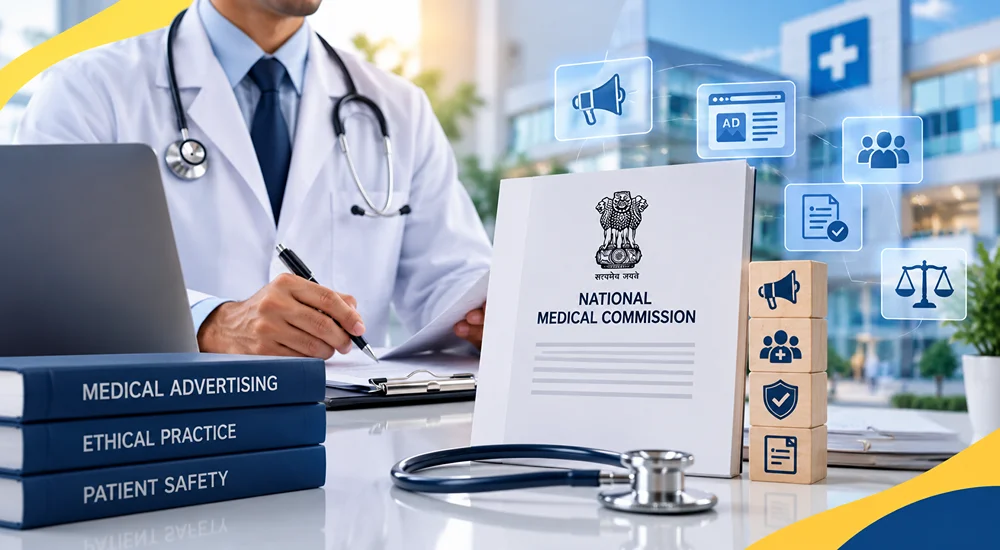
On 6 October 2026, the National Medical Commission (NMC) released new guidelines on how doctors and hospitals in India can advertise. The rules started the same day, with no grace period.
If you market a clinic, hospital, diagnostic centre or medical practice, some of your content may no longer be allowed. Here is what the NMC advertising guidelines change, in plain language.
Who the rules apply to
The guidelines cover every registered doctor in India and every hospital or medical institution. Healthcare platforms that list doctors must follow them too, and cannot sell top spots in doctor rankings. Agencies and influencers are covered indirectly, because what they post for a doctor or hospital still counts.
What now counts as advertising
The definition is wide. Anything that promotes a doctor’s or hospital’s services, skills, achievements or facilities counts as advertising, in any medium. That includes social media posts, reels, podcasts, sponsored and search ads, influencer content, and AI made content.
General health information that isn’t meant to promote anyone is exempt. So are plain facts about equipment or facilities, as long as they don’t claim to be better than others or promise results.
Doctors posting online should also show their name, qualifications, registration status and SMR/NMR registration number. Hospital posts should show the same details for their doctors.
What is banned
- Patient testimonials: Doctors cannot ask for or share patient testimonials or reviews for promotion on social media. Even with the patient’s permission, a banned testimonial stays banned.
- Fake or paid reviews: No doctor or hospital can ask for, buy or rig fake, paid or misleading reviews and ratings, or buy followers, likes and views.
- “Best” and “No.1” claims: Doctors cannot call themselves “Best doctors” or “No.1 Specialist”. Claims like “leading” or “most trusted” need fair, independent proof.
- Promises: “Guaranteed cure”, “100% success” and “painless treatment” are out.
- Before-and-after photos used for promotion.
- Offers that push people into visits or tests they don’t need, like discounts, coupons or free procedures. You can still show your fees clearly.
- Fear-based marketing, and sharing any patient’s name, face or identifying details.
The new rules on AI
AI-made doctors’ ad campaigns for commercial gain are banned. Any other AI-made promotional content must clearly say it was made with AI. AI cannot be used to create fake patients, fake testimonials or fake endorsements, and patient data put into AI tools must follow privacy rules.
In practice, an AI avatar of a real doctor or an AI-generated “patient” is not allowed.
Our agency posted it” is no longer an excuse
If an agency, influencer or platform posts something for a doctor or hospital, the doctor or hospital is still responsible if they approved it, paid for it or knowingly allowed it.
Fees matter too. Agencies, influencers and platforms cannot be paid based on the individual patients they bring in. In our view, a fee per booked appointment is risky, and a monthly retainer or a fee for the work itself is safer.
What you can still do
Hospitals can share clear facts that can be checked: location and contact details, departments, facilities, equipment, emergency services, accreditation, fees and a directory of their doctors. Doctors can announce a new practice or a change of address, share their fees, and take part in health awareness and education, as long as they don’t use it to promote their own practice.
Penalties
State Medical Councils handle cases against doctors, and the penalty gets stricter with each violation. It starts with a warning and ethics training, then censure and a fine, then suspension for 3 to 6 months. Serious violations, like misleading cure claims, can mean suspension for 6 to 12 months. Repeated violations can lead to removal from the medical register for 1 to 3 years. Doctors get a notice and a chance to explain first, and can appeal within 60 days.
A quick checklist
- Remove testimonials, before-and-after images and review screenshots used for promotion.
- Rewrite any “best”, “No.1”, “guaranteed” or “100%” claims.
- Add the doctor’s name, qualifications and registration number to posts that feature a doctor.
- Label AI made promotional content.
- Review your offers, agency fees and influencer deals.
The shortcuts are gone. Good marketing is not.
These rules are good for patients, and good for marketers who do the work properly. Useful health education, clear facts and a website that answers patients’ questions still work. They are now the only things that work.
At Addinfi, healthcare is one of the industries we focus on. If you want a second pair of eyes on your content, ads or website against the new guidelines, talk to our team.
This article is for marketing guidance and is not legal advice. Last updated 8 October 2026.
Sources
- NMC Public Notice R-13014/01/2024-Ethics (6 October 2026)
- Deccan Herald (7 October 2026)